Recently, we rolled out a survey to 1000+ photographers who use Aftershoot to understand the nitty grits of their post-photography workflow and their outlook towards business in 2026 and beyond.
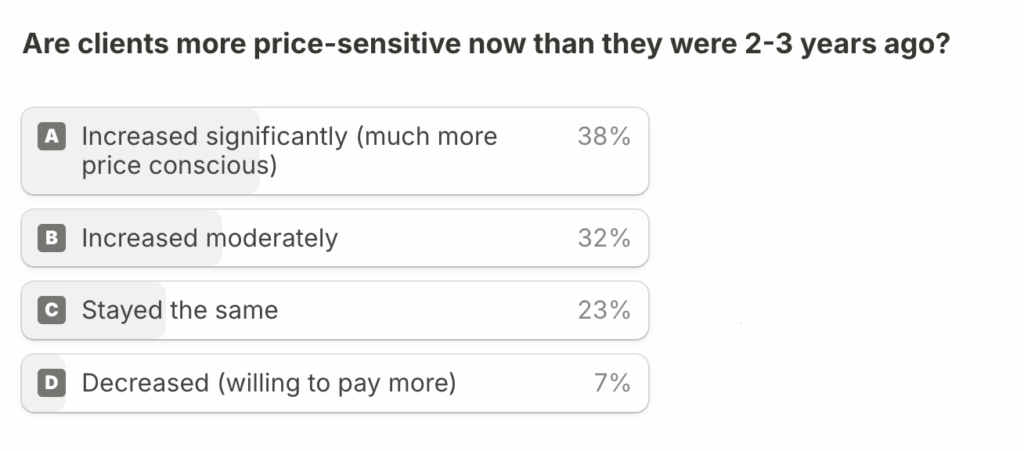
We asked, “are clients more price sensitive now than they were 2-3 years ago?.” Not-so-shockingly, we learned,
70% photographers noticed clients were more sensitive to prices 2025 than just 2-3 years ago (and that tension showed up in bookings.)
Interestingly, in a follow up question that asked about their strategies to book more clients in 2026, an overwhelming majority responded with strategies like investing more time to create more premium and personalized experiences, developing unique artistic styles, and a few others but NOT CUTTING PRICES.
Only 7% of these same photographers planned to respond to the market by cutting their prices.
We’ll talk more about these strategies and more in the second half of this article. But context is important, so keep reading.
We went looking on subreddits, photographer blogs, forums, and dug through industry reports to understand if this paradox echoed the voices in the larger industry too, and the short answer is, YES.
Photographers are refusing to cut prices despite low bookings through 2025 and 2026. And for multiple very good reasons.
They’re holding the line on price right now are just behaving rationally in a market that has quietly turned hostile to both couples and creatives.
On one side, clients are squeezed by a cost-of-living shock; on the other, photographers are being asked to deliver 2025-level production value on 2015 pricing, and the math simply does not work.
In this article, we deep dive into the economic and psychological stressors that have brought the industry to this juncture, and understand how photographers around the globe are responding, adapting, and planning to thrive in this new status quo.
If you want to get the full scoop from the state of photography 2025 before you jump into the specifics of the pricing sensitivity crisis, the report is free to download. This report also found how 81% of photographers who adopted AI in their workflows actually regained work-life balance and breaks down their tried-and-tested methods.
Grab your copy here:
The new economics of “I love your work, but…”
Over the last few years, inflation has made everything more expensive and then… stayed there.
In the UK, consumer price inflation peaked at 11.1% in October 2022 before easing toward the 2% target, but “easing” only meant the rate of increase slowed – those higher prices for food, housing, energy and fuel never rolled back down.
Across the US and Europe, wage growth and economic output have been far less dramatic than energy and essentials, leaving households feeling permanently behind even when the headline inflation number looks calmer.
That economic tension shows up brutally in weddings and family milestones. Recent data from The Knot and Experian puts the average US wedding around the low–mid $30,000s, with surveys suggesting 2024 couples spent about $33,000 and projections from planners and registries pushing that toward roughly $36,000 for 2025.
Media reports also highlight more couples paying for weddings themselves, hiring around ten vendors on average, and then cutting guest lists, traditions and “extras” just to stay afloat. When the single biggest line items – venues, catering, and yes, photography – keep climbing, it is no surprise that couples go “value-shopping,” collecting quotes, shopping directories, and trying to negotiate every number on the spreadsheet.
Then, social media pours fuel on this psychology. Platforms like Instagram, TikTok, Pinterest and vendor marketplaces are saturated with highly curated work from luxury and upper-mid market photographers, which then gets mentally benchmarked against whatever local quote lands in a couple’s inbox.
Industry commentary notes that national “average wedding cost” numbers obscure the reality that most couples are spending less than the headline figure but being fed visuals produced on far bigger budgets, creating a permanent gap between what they want and what they can actually afford.
When about two-thirds of couples are now using social platforms and digital tools to discover and compare vendors, this turns into a giant, always-on price-comparison engine with almost no context about how those numbers were set.
This anxiety you may be feeling about the state of photography today is not just in your head, as evidenced clearly by many such accounts from photographers who’ve been in the field any between two years and two decades.
Inside the race to the bottom
In forums, blogs and private groups, there is a steady drumbeat of posts about newcomers offering “hundreds or thousands of images” for fees that barely cover fuel and software, and about real-estate and stock shooters seeing license fees drop to a few dollars per image.
In stock communities, contributors talk bluntly about “insulting” payouts on major platforms and a sense that AI and microstock have taught clients that visual assets should be effectively free.
On the commercial and real-estate side, Matterport, virtual tours and bundled media packages are now fought over at increasingly low rate cards, reinforcing the perception that if one photographer will not say yes, another cheaper one always will.
A 2025 feature on photographer burnout describes clients who “expect 2015 prices with 2025 expectations,” linking that disconnect directly to exhaustion, disillusionment and people leaving the field.
Coaching sites that analyze failing photography businesses consistently return to the same diagnosis: chronic under-pricing, failure to calculate a realistic cost of doing business, and a belief that lower rates will be made up in volume that never actually materializes.
Underneath the romanticized narrative of “doing what you love,” a far more boring reality that many photographers are, once all hours and inputs are counted, earning less than minimum wage for work that carries real liability and emotional pressure.
PS: If you haven’t calculated your Cost of Doing Business yet, you’re missing the foundational piece in your revenue intelligence. We built a simple, free-to-use calculator that’ll get your numbers straight in under a minute. Access it here: Aftershoot’s Photography Pricing Calculator
Why the smartest photographers are saying NO to cutting prices
If fuel, rent, insurance, gear, subscriptions and printing costs have risen in line with or above inflation, then holding prices flat is functionally equivalent to accepting a pay cut on every single booking.
Photographers who have done a proper cost-of-doing-business analysis know that once pre-production, travel, shooting, culling, editing, delivery, admin, marketing and tax are factored in, slicing 20–30% off a quote means winning unpaid labour in the guise of a client.
Pricing is part of the storytelling that says “this is a considered, premium service,” not a commodity competing in a search filter by lowest fee.
That said, competing by search filters is also very important for lead generation but it HAS to be done strategically. Spray-and-pray approaches almost never work. Here’s a neat mini-case study from a Redditor who shared their lead-gen mechanisms, an excellent display of what informed lead-gen systems look like:
If you know what is driving real business, you can invest more time and money there. This takes a few permutations and combinations, and quite a bit of experimenting but you’ll get there.
There is also the brand and positioning dimension that clients rarely see. Industry mentors and platforms aimed at working professionals warn that persistent discounting does not just trim margins; it fundamentally reshapes who enquires in the first place.
Free work is probably not the path to more and sustainable business in the long run. Free stuff is loved, but not valued, right?
Lowering rates tends to attract buyers who are primarily price-driven, quicker to question boundaries, and less loyal long-term, while simultaneously signaling to higher-intent clients that the work might be lower quality or the business unstable for once-in-a-lifetime moments like weddings and newborn sessions.
How they’re adapting everything except the price
The strongest businesses are re-engineering scope, packaging and operations instead of touching the core day rate. Wedding and portrait shooters, for instance, are rolling out 4–6 hour coverage, elopement and courthouse packages that come in at lower total ticket sizes but preserve a healthy hourly rate.
They are building clearly tiered collections – three packages with varied coverage, products and add-ons – which allow budget-conscious couples to trade down on time, albums or second shooters rather than chiselling at the base fee.
Adapting to current trends is going to be critical for survival, but that doesn’t mean slashing your prices. Its more about pricing appropriately. Here’s some perspective:
Mini-sessions and seasonal offers play a similar role. Rather than being stealth discounts on full sessions, they are tightly constrained products: shorter slots, fewer delivered images, fixed locations and back-to-back scheduling that keeps the effective rate where it needs to be.
In parallel, there is a distinct move away from selling “files” and toward bundling experiences and physical value: timeline consultations, wardrobe and location support, liaison with planners, followed by albums, framed prints and keepsake boxes that carry their own margins instead of expecting profit to live only in a session fee.
Our 2025 photography industry survey found the same perspective echoing through strategies photographers are adopting going into 2026 to win more clients, instead of cutting prices.
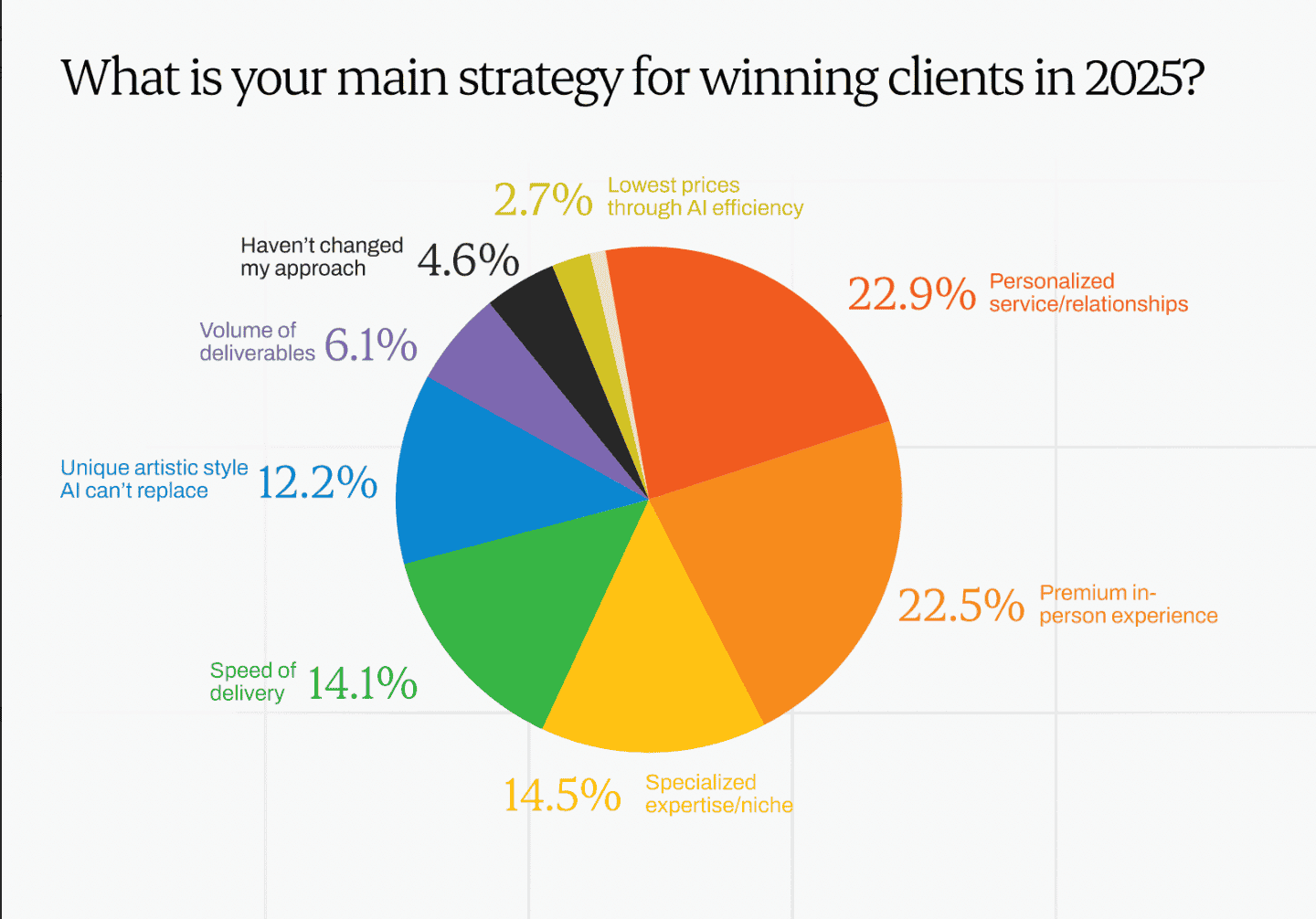
Instead of cutting prices, photographers plan to double down on relationships (60%) and premium experiences (59%) to create experiences worth paying for.
That means, time becomes money quite literally.
There’s a band of systems and software doing quiet but important work to help save that time from mindless, repetitive tasks so you can reinvest the same into curating memorable experiences for clients that command premiums.
AI-assisted culling and editing tools, business CRMs and pricing calculators are now common in professional workflows, allowing photographers to reclaim hours of post-production and admin while maintaining or even shortening turnaround times.
Industry commentary on AI’s role in photography stresses this “amplifier” function by reducing the cost in time and stress of delivering consistent, high-quality images, these tools make it viable to hold or raise prices without degrading the client experience.
When paired with transparent, easy-to-understand price pages and education-heavy content that walks clients through what they are actually paying for – gear investment, backup systems, insurance, storage – the entire model becomes more defensible in conversation.
Payment structures are another quiet lever. Rather than dropping the overall fee, many photographers are stretching payment plans, taking deposits earlier and splitting balances into more, smaller installments so that the monthly hit feels manageable for clients living with higher baseline expenses.
For couples, this reads as “more affordable” or “doable,” even though the underlying price has not changed. For the photographer, it preserves the integrity of their pricing while smoothing cash flow in a volatile market.
Broadening horizons with volume work to improve predictability in bookings and keep steady streams of revenue, repackaging services to make the gig sustainable for both you and your clients, doubling down on lead generating systems that work for you – all are excellent ways to go about it. But not cutting prices.
The new client conversation about price
Listen to enough workshops and blog Q&As, and a surprisingly consistent pricing script emerges among photographers who refuse to negotiate down. First, they anchor the fee in market reality, referencing national or regional wedding and portrait averages and then clearly stating where they position themselves – perhaps slightly above the median, in line with other boutique studios, or at a premium tier that matches their style and demand.
Then they walk through the “invisible labour”: planning calls, travel, backup gear, hours at the computer, redundancy in storage, and long-term archiving that ensures files are not just delivered but protected.
From there, the discussion shifts away from line items and toward risk. For once-in-a-lifetime events, photographers reframe their fee as a hedge against regret – there is no second chance to re-stage vows, first steps or multi-generational family portraits if the cheapest option fails.
The proof is carried by full galleries, testimonials that praise responsiveness and calm under pressure, and stories about troubleshooting chaos on the day, all of which make the number feel less like payment for “pretty pictures” and more like insurance plus expertise.
Pricing psychology – three tiers, a clearly marked “most popular” middle package, add-ons designed to make upgrades easy – quietly supports this narrative without turning the process into a negotiation over every single feature.
In this landscape, the photographers who hold firm on price are acknowledging that the economic pressure is real on both sides and choosing to adjust levers that do not destroy the foundation of their business.
Scope instead of rate, structure instead of panic discounts, systems and support instead of silent, unpaid overtime.
In a world where everyone is being nudged toward the lowest possible number, the refusal to join the race to the bottom is, paradoxically, what keeps the work – and the workers – standing.
Aftershoot is always here to cut your biggest time sink, post-processing, by more than half the time it usually takes and reduce that unpaid labor photographers have quietly accepted to be the norm. The more you work with Aftershoot, the better it learns your style, and saves more you more hours of repetitive work, directly helping your business’ bottomline and your work-life balance improve, without compromising on either.
If you’re new here, you should know that Aftershoot is free to use for 30 days.
If you have stories or advice to share on this topic or something else, and would like to be featured on our blog and socials, which reach thousands of photographers across the world, come say hi at [email protected].
We’re always looking for stories photographers will appreciate, and would love nothing more than to get your word to our community. ❤️